|


There appears to be photographic evidence of recent human activity on Nikumaroro prior to the arrival of the island’s first settlers. There are marks on the ground, visible in an aerial photograph taken on December 1, 1938, which are identical in appearance to known trails or footpaths appearing in later aerial photos. The apparent footpaths in the 1938 photo appear in a location we suspect as being the site of the castaway’s campsite where human remains were found in 1940.We also said:
It is, of course, possible that the features which resemble trails are some naturally occurring phenomenon that we do not at present understand, but if they are evidence of human activity the implication is that someone was active on a remote section of the island in the years immediately prior to 1938.Our subsequent work on the island has not turned up any natural explanation for the “trails,” but we have identified a possible explanation for at least one of them. Among the signs of human activity at the Seven Site are two locations, each of which contains the shells from exactly 15 giant clams.
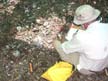
Tom King records one of the clam features.
Several of the shells are broken in a manner that suggests that some of the clams were bashed rather than pried open.
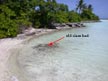 One
of the apparent trails leads from the part of the Seven Site where the
clam shells were found, through the buka forest, to a specific point on the
shore of the lagoon,where there was once a clam bed. It’s the only place
along the shoreline on that part of the island where evidence of a former
clam bed has been found. In retracing the trail on the ground, matching the
1938 aerial photo to current satellite photography, we found that the route
follows the easiest path in terms of terrain and vegetation between the two
points.
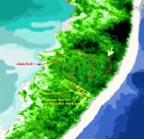
One
of the apparent trails leads from the part of the Seven Site where the
clam shells were found, through the buka forest, to a specific point on the
shore of the lagoon,where there was once a clam bed. It’s the only place
along the shoreline on that part of the island where evidence of a former
clam bed has been found. In retracing the trail on the ground, matching the
1938 aerial photo to current satellite photography, we found that the route
follows the easiest path in terms of terrain and vegetation between the two
points.
 In
light of those observations it is very difficult to see the feature in the
1938 aerial photo as anything but a man-made trail connecting an exploitable
food source with an occupied campsite where the food was consumed. Other
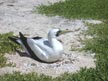
apparent 1938 trails lead into the buka forest where birds abound and to
the ocean shore where turtles come ashore to lay their eggs.
In
light of those observations it is very difficult to see the feature in the
1938 aerial photo as anything but a man-made trail connecting an exploitable
food source with an occupied campsite where the food was consumed. Other
apparent 1938 trails lead into the buka forest where birds abound and to
the ocean shore where turtles come ashore to lay their eggs. |
Click on each topic to read our results and reasoning, and to see photographs of the artifacts recovered:
|