|
February 22, 2002
|
Mysteries of the Seven Site
|
| 2-6-S-21a | 2-6-S-21b | 2-6-S-16 | 2-6-S-18 |
 |
 |
 |
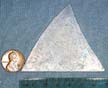 |
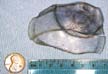
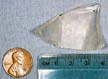
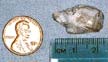
These are the glass fragments which we suspect are beachcombed objects which were used as cutting tools by the castaway. They are currently in the custody of Dr. Rob Jackson, an archaeologist in California with extensive experience in the evaluation of prehistoric tools. Here's an excerpt from his preliminary report:
I have had an opportunity to take only a quick look at each of the glass artifacts so far. None appear to have secondary flaking (retouch) or obvious micro-flaking that may reflect heavy use. ...
Microflaking would not be expected for an unmodified flake tool that was used to cut soft material --- even butchering. Anyone who knows how to butcher properly would avoid cutting into bone and damaging the tool edge. In other words, there is no obvious evidence of modification of the glass for use as tools. I looked at the newsletter sent with the glass artifacts and noted that some of the descriptions stated that the glass artifacts can be held "comfortably" or "safely" in the hand. I would caution against the "ease of prehension" argument, which I sometimes see in reports. Five million years of evolution have resulted in hands that accommodate all sorts of shapes.
I will examine each artifact and describe the fracture patterns as well as both macro and micro wear, including striations that may reflect use.
| 2-6-S-43 | 2-6-S-21f | 2-6-S-32 |
Identified: Anode Plate |
 |
 |

These artifacts appear to be internal components of one or more radio vacuum tubes. Although the exact tube or tubes they come from have not yet been pinned down, there is little doubt that we now know, in a general sense, where these things came from. The tubes were far too large to be associated with any of the radios aboard Earhart’s Electra and it seems most likely that they were burned out or otherwise unserviceable components from the wartime Coast Guard Loran station which were brought to the Seven Site and used for informal target practice. We know, both from anecdotal accounts and from M-1 carbine shell casings and pieces of shattered dinner plates – one with the Coast Guard logo – that such activity took place at the site on at least one occasion. At this time at least, it does not look like the “Hi-tech”artifacts are part of the castaway puzzle.
The Knob
| 2-6-S-45 |
|
Identified. See “The Knob That Wasn’t.” |

| 2-6-S-03a | 2-6-S-03b |
 |
 |
These continue to utterly confound attempts to identify them. The closest we have been able to come is to note their apparent resemblance to fasteners seen in a low-resolution internet photo of a sextant box in a Portuguese collection. If that is what they are it could be an important link to the castaway, but the jury is still very much out on this question. As always, more research is needed.
Faunal Material
In addition to the various artifacts, a considerable amount of faunal material – fish bones and scales, clam shells, turtle bones, and bird bones – was recovered from the Seven Site. These were found in what appear to be meal sites and often show evidence of association with fire. Dr. King has distributed the faunal material to various experts for analysis so that we might learn what we can about just how many and what sort of critters were being eaten and how they were prepared. With that knowledge we should be able to make an informed judgement about whether we are looking at lunch leftovers from a Gibertese work party or the last meals of the castaway. So far, we’re seeing evidence of activity that is much more consistent with what might be expected of an inexpert person from a European/American culture than that of Pacific islanders.
Two deposits of clam (Tridacna) shells, representing exactly 15 clams in each, were found at the site and, as described in the November TIGHAR Tracks, some of the shells were broken rather than pried open. We have since learned that island people rarely harvest the whole clam and carry it home. The clams are hard to pry off the bottom but the bigger ones can’t fully close their shell so the islanders just remove the meat and leave the shell in the water.
Equally interesting are the results of expert analysis of the turtle remains we found at the site. It looks like we have a single animal, which would match Gerald Gallagher’s description of the castaway campsite: “Body had obviously been lying under a ‘ren’ tree and remains of fire, turtle and dead birds appear to indicate life.” It was probably a Green Sea Turtle (but DNA testing will tell us for sure) in the neighborhood of maybe 200 pounds but the odd thing is that the head and limbs are missing. This suggests that the turtle was butchered where it was found and killed – probably out on the beach while laying eggs – and only the meat and shell brought to the site. Island peoples, in contrast to their clam practices, usually carry the whole turtle, still alive, back home and keep it on its back until they’re ready to cook it and eat it.
A sample of charcoal from the site is in New Zealand for radiocarbon dating. This certainly won’t pin down whether the fire dates from 1937 or 1940, but will tell us if we’re looking at a prehistoric site and assuming that it's much more recent.
Archaeology is a painstaking and often frustrating process, and as we’ve often said, the real discoveries usually happen in laboratories and archives, not in the field. Bit by bit, the picture of what happened at the Seven Site is starting to come together. So far, the best candidate for the star of this pilot episode of Survivor is still Amelia Earhart, but much work remains to be done.
Your continued support makes it possible. Thank you.