|


Gallagher, in his October 17, 1940 telegram to the Secretary of the Western Pacific High Commission, says, “Body had obviously been lying under a ‘ren’ tree and remains of fire, turtle and dead birds appear to indicate life.” Ren trees (Tournefortia argentia) are quite common on Nikumaroro, so that is not much help, but for what it’s worth there is now a rather large ren tree right in the middle of the Seven Site.
Near the base of that tree, and at several other discreet locations nearby, we excavated numerous bird, turtle and fish bones some of which showed clear signs of having been in a fire.
Literally hundreds of bones were collected from meticulously excavated archaeological “units” (gridded areas). These will be examined by faunal experts to determine the size, number, and species of the animals and fish consumed at the site. Any information about methods of preparation or cooking will also be noted. If, for example, we find that the bones of deep ocean fish are present, that would argue against the fish being caught by a castaway. If, on the other hand, the bones represent fish that, although perhaps easy to catch on the reef or in the lagoon shallows, are not favored by Pacific islanders, that would argue for a castway. (Please click on each small photograph to open a new window with a large photo.)
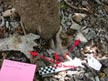
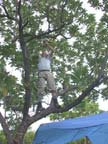
Left – Jim Morrissey in a ren tree at the Seven Site.
Right – turtle bones found at the Seven Site.
|
Click on each topic to read our results and reasoning, and to see photographs of the artifacts recovered:
|