 |




Unidentified Beige Material |
Report: Beige Concretion
This is the item discussed in this section:
Unknown beige concretion |
2-8-S-18 |
|
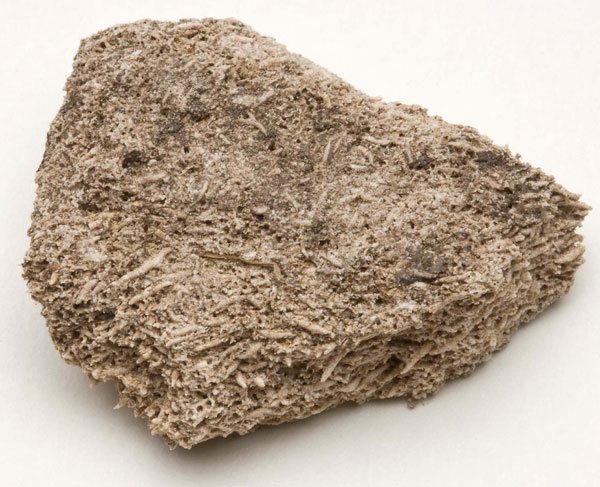
| 2-8-S-18 | |
From Report 71:
Results and Conclusions
|
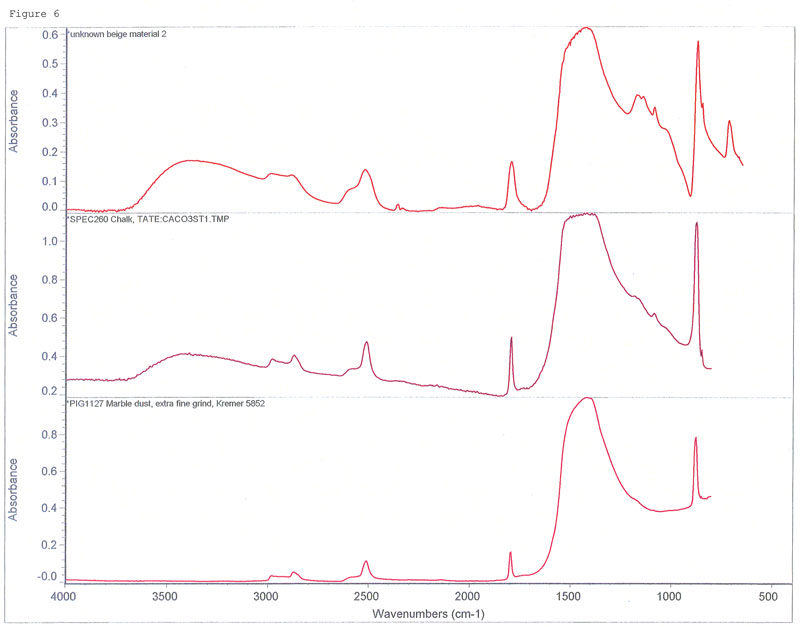
| Interpretation: |
|
WHAT We don’t yet know exactly what this is, but it seems safe to say it is not of human origin. |
Object Descriptions and Reason for Analysis • OBJECT DESCRIPTION (form, material, color, etc): The object submitted for analysis is archaeological material excavated from the Republic of Kiribati. It is an unknown beige concretion. • REASON FOR ANALYSIS: Could this object have an early twentieth-century American provenance? Could it have been manufactured prior to 7/2/37? What is the beige concretion and does it have any relevance to anthropogenic activity at the site? • SAMPLING: All samples for chemical analysis were transferred to glass containers to prevent contamination prior to analysis. All other analyses were performed nondestructively. • ANALYSIS PROTOCOL: Fourier transform infrared spectroscopy (FTIR) was used to identify the molecular composition of the beige object. |
Click HERE for a PDF of Report
71. (2.1 MB)
Click HERE for a PDF of Report 88. (2.2 MB)







Click HERE to see a photo gallery from Niku V.
Your continued support is vital. Artifact analysis and research is already well begun and we need to do much more. To make a contribution to the Earhart Project click here.
To join the expedition’s growing family of corporate sponsors please contact TIGHAR executive director Ric Gillespie by email or by phone at 610.467.1937.
 photekimaging.com |
 digitalglobe.com |
 markertek.com |
 thursby.com |
 sibfla.com |
 journeysaviation.com |
 lehightesting.com |
|
 whiteselectronics.com |
TIGHAR is a 501(c)(3) public charity. All contributions are tax deductible to the full extent of the law.
 |
 |
 |
 |
 |
 |
 |
 |
 |
 |
 |
Copyright 2021 by TIGHAR, a non-profit foundation. No portion of the TIGHAR Website may be reproduced by xerographic, photographic, digital or any other means for any purpose. No portion of the TIGHAR Website may be stored in a retrieval system, copied, transmitted or transferred in any form or by any means, whether electronic, mechanical, digital, photographic, magnetic or otherwise, for any purpose without the express, written permission of TIGHAR. All rights reserved. Contact us at: info@tighar.org • Phone: 610.467.1937 • JOIN NOW |