2-2-V-1
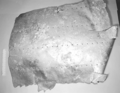
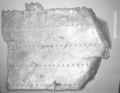
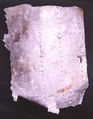
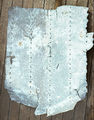
A piece of Alclad aluminum of the type known to have been used to repair aircraft in the United States. It seems reasonable to assume that this kind of sheeting would have been used in the repairs after the crash at Luke Field.
"Although still of undetermined origin, the section of aluminum airplane skin (Artifact 2-2-V-1) found on the Niku II expedition in 1991 exhibits damage that is consistent with its being torn from an aircraft by powerful surf action. The piece has no finished edges and was literally blown out of a larger section of aluminum sheet from the inside out with such force that the heads popped off the rivets. The interior surfaces exhibit none of the pitting that is normally left by an explosion and one edge clearly failed from fatigue after being cycled back and forth at least twice. The artifact was found on the island’s southwestern shore in the debris washed up by a violent storm."[1]
"All aspects of the artifact, including the rivet pattern, fit closely with a section of the belly on the right hand side of the aircraft between stations 269 5/8ths and 293 5/8ths. The apparent discrepancy in the spacing between stringers may be due to distortion due to the deformation of the fragment of skin when it blew out of the belly. The one known discrepancy between the rivet holes in the artifact and standard Electra construction is the line of 5/32" holes along the one edge. The standard airplane has a double row of staggered 3/32" rivets along the keel where the skins overlap. The artifact shows evidence of a double row of staggered 5/32 rivets. Aris Scarla sees the use of larger rivets along the keel in the repair as a reasonable possibility in the repair of NR16020."[2]
The National Transportation Safety Board Lab in Washington and the ALCOA Aluminum Lab in Pittsburgh have examined and tested the artifact. Their findings are:[3]
- The sheet is .032 2024 (formerly known as 24ST) ALCLAD
- The surviving rivet is a 2117 AN455 brazier head 3/3 or AN456 3/3 modified brazier head. Attached photo NTSB-rivet.jpg is from the NTSB report.
- The underlying structure to which the rivet was attached was approximately .06 inch thick
- The lines of 3/32nd rivet holes have a pitch of 1 inch.
- The larger rivet holes along one edge imply the presence of a staggered double row of 5/32nd rivets with a pitch of 1.25 inches except for an irregularity at the "tab" (H in the NTSB photo).
- As shown in attached photo AD-on-skin.jpg, the letters AD are faintly visible on the surface of the sheet. They are etched remnants of the original labeling applied by ALCOA. The unique style (font) of the letters enabled ALCOA to identify the full designation as ALCLAD 24S – T3 AN - A – 13. Incidentally, the dark greenish material on the surface of the skin has been chemically tested. It is organic, not paint.
- The labeling indicates that the sheet was manufactured by ALCOA not earlier than 1937 (when the T3 process was introduced) and not later than 1954 (when 24ST became 2024). The “13” signifies that it is “reserve stock” sheet that has been certified for uses other than original construction (i.e. repairs).
- Normally, the labeling is “rolled on” automatically as the sheet is manufactured and is aligned with the edges of the sheet. According to sources at ALCOA the non-aligned labeling on 2-2-V-1 suggests that it was applied by hand-stamping which may indicate that it was part of a very early and small production run.
Photo Gallery
-
-
-
-
-

-

-
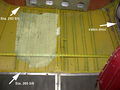
-

Rubbing of 2-2-V-1.
-

CAD drawing; units are decimal inches.
-

Rubbing of underside of NEAM Electra
-
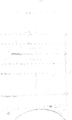
Rubbing from top of NEAM Electra
-
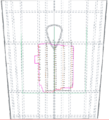
Overlay--possible match on top.
-

-
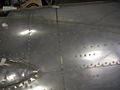
Exterior air scoop.
-

Exterior air scoop.
-
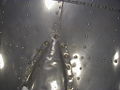
Exterior air scoop.
-
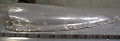
Exterior air scoop.
-

Exterior air scoop.
-
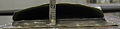
Exterior air scoop.
-
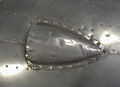
Exterior air scoop.
-
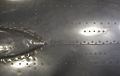
Exterior air scoop.
-
-
-

-
-

-
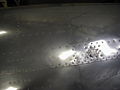
-

Interior air scoop.
-
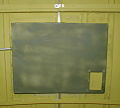
Interior.
-
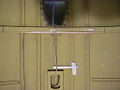
Interior.
-
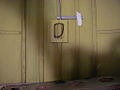
Interior.
-

Interior


.png)


References
Related articles
- "We Did It!", TIGHAR Tracks, March 12, 1992--a plausible location was found on the Electra airframe where the sheet might have been used to repair damage.
- NTSB report.
- "Found Objects", Tighar Tracks, September 30, 1996.
- Summary observations.
- "Back to Square One"--trying to find another location where it might have fit on the plane.
- "The Riddle of Artifact #2-2-V-1" (22 May 2014).
- "Cliffhangers Galore: Will Niku VIII sail this year? An End to the Lawsuit? A Smoking Gun At Last?" (8 July 2014).