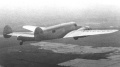
Lockheed Electra 10E Special - NR16020
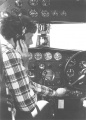
Joe Gurr: "The airplane, a Lockheed No. NR 16020, was really fascinating. It was obviously engineered and equipped for very long non-stop flights. The fuselage was solid gasoline tanks, two rows of them, from bulkhead to bulkhead, with just enough room between the tops of the tanks and the overhead for a person to be able to crawl from the stern to the cockpit on their tummy. Located in the stern, just opposite the main entrance door was a small table for the navigator's use. The radio transmitter was installed above this table. Jammed in what space they could find was a toilet."[1]
- "Gurr's recollections do not correspond exactly to what is known about the aircraft: there was just one row of tanks, the transmitter was below the table, and the toilet was in a standard location."[2]

Powerplants
"Lockheed had introduced the Model 10A Electra in 1934. Powered by two Pratt & Whitney Wasp Jr. SB engines of 450 h.p., the type enjoyed widespread success as a ten-passenger airliner. Deliveries of the 10E variant, featuring the more powerful 550 h.p. Wasp S3H1, began in January 1936. Earhart’s was the fifth airframe so equipped." [3]
"There's no such thing as a 'Wasp Senior.' The P&W R1430 was known as the 'Wasp.' The Model 10A Electra carried the smaller R985 which was dubbed the 'Wasp Junior' but nobody ever referred to the big engine as a 'Wasp Senior.' All Model 10Es were built with P&W R1430 S3H1 Wasp engines and NR16020 was wearing the same engines it was built with when it disappeared."[4]
Windows come and go
"As delivered in July 1936, the airplane had only two windows in the cabin. These were the aftmost standard airline windows and were directly opposite each other. Then in January of 1937 a window was installed in the cabin door on the port side and a larger-than-standard window was installed on the starboard side. This last window is the one that was later skinned over in Miami."[5]
Weight and Fuel Capacity
The License Authorization says "Weight empty as equipped 7265 lbs. (see equipment reverse side)."
On the reverse side it says, "Gas tanks: 6 in wing @ 394 gal. 6 in fuselage @ 754 gal." That's a total of 1148 gallons.
This was when the airplane was registered as R-16020 and it was sometime before 27 November 27 1936 when the total fuel capacity was increased to 1151.
At the bottom of the reverse side of the License Authorization it says:
The following values shall be considered when computing the gross load:
- Gasoline at 6 lbs
- fuel oil 7 lbs
- Lubricating oil 7.5 lbs per gallon
- Weight of equipment not listed above
- Passengers and crew at 170 lbs each
- Baggage and cargo at actual weight
| Item | Weight |
|---|---|
| Airframe | 7265 |
| 1151 gallons of fuel @ 6 lbs per gallon | 6906 |
| Fuel oil @ 7 lbs per gallon | |
| Lubricating oil @ 7.5 lbs per gallon | |
| Other equipment | |
| 2 crew @ 170 lbs each | 340 |
| Total: | |
| Baggage and cargo |
Earhart said her plane's Gross Weight was about 15,000 pounds when fully loaded with 1150 US Gallons of fuel.
Battery System
The batteries were Exide 6-FHM-13-1, 12-volt, lead-acid type, with 85 AH capacity.
Each battery could be switched onto or off the main electrical bus. We assume both batteries were fully charged on arrival at Niku, and that Earhart kept one on the bus, with the other off-bus as a safety standby.
The generator was an Eclipse type E-5, rated to provide 15 volts DC, mounted on the starboard (right) engine. A crucial question for our analysis was whether the E-5 would deliver 15 volts when the engine was idling at 900 RPM. Paul Mantz, Earhart's technical advisor, said in 1937 that the Pratt & Whitney Wasp S3H1 engine--the type used on the Electra--burned 6 gallons per hour at 900 RPM. TIGHAR verified the engine and generator performance in 2009, in an experiment using an S3H1 engine and an E-5 generator. This result established that 900 RPM was the lowest speed Earhart could use for battery charging, and that she would burn 6 gph while doing so.
The time required to recharge the battery after a transmission period, and the associated engine fuel burn, are important considerations in the post-loss signals.
Ideally, we would have the Electra battery charging specifications, but we have been unable to find that information. We could not use a modern 85 AH battery as a proxy because we could not be sure that the the internal resistance and charging efficiency of the 1937 battery were the same as in a modern battery. Therefore, it was necessary to derive the battery's performance parameters from first principles, using published empirical research data for aircraft lead-acid batteries of the period.
Aircraft lead-acid battery cells of the period had a specific gravity range of 1300 at full charge to 1110 at fully discharged, with corresponding voltage range of 12.86 volts to 11.81 volts.
The transmitter high-voltage power supply was a dynamotor that drew 65 amps at 12 volts, and thus could function at virtually full output even with the battery approaching zero charge. Hence, the combined available "end game" battery charge--after all engine fuel was exhausted--was 170 AH, if both batteries were fully charged at fuel exhaustion.
The credible post-loss signals occurred in clusters, or blocks. We assume that Earhart kept the engine running to operate the generator continuously during each block, rather than start and stop the engine for each transmission. We have developed a computer model that does the time line bookkeeping, giving the battery state of charge (SOC)--and fuel remaining--after each credible signal, and after a user-specified recharging period following each signal block. After we have identified all the credible post-loss signals, we'll plug them in to the model and see how battery charge and fuel consumption behaved over time.
Of course, the amount of fuel Earhart had on arrival at Niku depends on when she landed. We don't know exactly when that was , but we know the latest possible arrival time, which was constrained by tide depth on the reef. The maximum safe water depth for landing the Elctra was 6 inches (0.15 meter). Signal propagation analysis for the last Earhart signal heard by the Coast Guard cutter Itasca on July 2, 1937, gives us a bound on Earhart's distance from Niku then, and thus her earliest possible arrival time. These two limits bound the uncertainty of fuel remaining on arrival, and factor into our analysis.
The tide level also constrained when Earhart could run the engine for battery charging. The required propeller tip clearance was 24 inches (0.6 meter), so engine operation was impossible when the water level exceeded that limit.
Now, let's take a brief look at the dynamics of the electrical load and battery recharge.
The generator output current was regulator-limited to 50 amps.
We assume an ambient current load of 8 amps during each signal block: radio receiver on (1 amp), transmitter in standby (6 amps for vacuum tube filaments), and the cockpit instrument lights (2 amps).
The transmitter drew 65 amps when transmitting, raising the total current load to 68 amps.
With the transmitter in standby, the generator could supply the 8 amp ambient load and have current to spare for charging the battery. But when the transmitter was keyed, the generator could supply only 50 of the required 68 amps. The battery would supply the remaining 18 amps, losing 18 ampere-minutes (0.3 AH) of charge for each minute of transmission time. About 13 minutes of charging time was needed to restore charge for each minute of transmission time, if the starting battery SOC was near the top of the exponential charging curve. At lower starting SOC, where the curve is steeper, the recharge time was on the order of 2 minutes for each minute of transmission.
Earhart's only way to monitor battery SOC was to watch the generator current output on the ammeter. The current would decrease toward the 8-amp ambient load as the battery approached full charge. But it could take a long time to get those last few ampere-hours into the battery if she wanted to recharge to 100%, and Earhart would have to be careful not to spend her precious fuel too lavishly. We don't know what strategy she used, but we can experimentally investigate the range of options and their effects using the computer model mentioned above.
Gallery
-
-
-

-
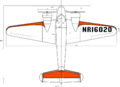 55' x 38' 7"
 -

-
-
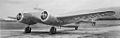
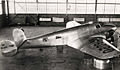 Wheeler Field
19 Mar 1937 -
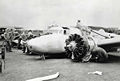 Luke Field
20 March 1937 -


| All drawings, images, and photographs ©TIGHAR 1985-2024. Not to be used, distributed, copied, bought, sold, or otherwise poached. For permission to use images, please email TIGHAR. |
References
- ↑ Joe Gurr to Fred Goerner, 3 May 1982.
- ↑ Ric Gillespie, 2 March 2009 Forum.
- ↑ TIGHAR Tracks 1995 11:2.
- ↑ https://tighar.org/smf/index.php/topic,290.msg2728.html#msg2728
- ↑ Ric Gillespie, 31 May 2000 Forum.
Related articles
- Radio equipment on NR16020.
- "The Earhart Electra, part I: A Star is Born," 31 May 1995 TIGHAR Tracks.
- "The Earhart Electra, part II: Around the World," 9 November 1995 TIGHAR Tracks.
- Lockheed Martin archive
- Lockheed Report 487 on the Electra's range.
- The Harney Drawings]--detailed plans for the interior and exterior of the Electra (available from TIGHAR).
- Lockheed 10-A.
- [1] "History Detectives Report: A Piece of the Grail?"]