Sextant box found on Nikumaroro: Difference between revisions
(document move of Naval Observatory calibration function to Norfolk) |
mNo edit summary |
||
| Line 50: | Line 50: | ||
In the engraving on the sextants, there is a symbol for the Naval Observatory between "U.S. Navy" and the number issued by the Naval Observatory. The symbol is an "N" superimposed on a square "O". The symbol is relatively clear in [[:File:2975engrave.jpg|this photograph.]] | In the engraving on the sextants, there is a symbol for the Naval Observatory between "U.S. Navy" and the number issued by the Naval Observatory. The symbol is an "N" superimposed on a square "O". The symbol is relatively clear in [[:File:2975engrave.jpg|this photograph.]] | ||
All the nautical instrument repair and calibration work was shipped off to Norfolk in the early 1950s. <blockquote>"Important though this work was, the Observatory was open to the criticism, especially from astronomers, that navigational instruments should be no part of the work of an astronomical observatory. This was undoubtedly part of the reason that the chronometer function was transferred in 1951 to the Norfolk Navy Yard, leaving only a small group of instrument makers who repaired and constructed the Observatory’s telescopes and other instrumentation, rather than navigational instruments."<ref>''Sky and Ocean Joined: The U.S. Naval Observatory, 1830-2000'', by Steven J. Dick, Cambridge University Press, 2003.</ref></blockquote> | All the nautical instrument repair and calibration work was shipped off to Norfolk in the early 1950s. <blockquote>"Important though this work was, the Observatory was open to the criticism, especially from astronomers, that navigational instruments should be no part of the work of an astronomical observatory. This was undoubtedly part of the reason that the chronometer function was transferred in 1951 to the Norfolk Navy Yard, leaving only a small group of instrument makers who repaired and constructed the Observatory’s telescopes and other instrumentation, rather than navigational instruments."<ref>''Sky and Ocean Joined: The U.S. Naval Observatory, 1830-2000'', by Steven J. Dick, Cambridge University Press, 2003; p. 507.</ref></blockquote> | ||
Any sextant marked "FE Brandis" is definitely a pre-1925 or so product. | Any sextant marked "FE Brandis" is definitely a pre-1925 or so product. | ||
Revision as of 20:48, 11 December 2011


When Gallagher did a thorough search of the area near where the skull was found, he discovered an empty sextant box with two numbers on it--3500 and 1542. The British saw no significance in the numbers; in 2009, TIGHAR found an intriguing pattern of dual numbers (maker's number and U.S. Naval Observatory numbers assigned when the instruments were inspected there).
The Brandis sextant boxes pictured here are approximately 10" x 10" x 5".
Notes from the bones file
- Telegram No. 71 from Gallagher to Jack Barley, Resident Commissioner, Ocean Island, Sept. 23, 1940
- Sextant box has two numbers on it 3500 ( stencilled ) and 1542--sextant being old fashioned and probably painted over with black enamel.[1]
- Typed note in file 4439-40 (23) from Vaskess to Sir Harry, April 11, 1941
- The sextant box with its contents is now with me. Perhaps Captain Nasmyth might be willing to examine this with a view to ascertaining the origin?
- Letter – circled 14. Vaskess to Commander G.B. Nasmyth, F.R. Met. Soc., Suva. June 6, 1941.
- Dear Commander Nasmyth,
- With reference to our telephone conversation relative to the identification of a sextant and box which I mentioned as having been found and which you were so good as to say you would examine, I regret to state that on further examination it was discovered that no sextant had actually been found but only a box thought to have contained a sextant.
- I am forwarding the box to you with this letter and His Excellency would be grateful if you would examine it with a view to determining its use and origin if possible.
- Sincerely,
- Secretary to the High Commission
- Sincerely,
- Typed note to file 4439-40 in red ink (39). Sir Harry to Vaskess. August 8, 1941.
- Sec., H.C.,
- I return the sextant box which I had retrieved from Captain Nasmyth in order to show it to Mr. Gatty who has expert knowledge of such matters. Mr. Gatty thinks that the box is an English one of some age and judges that it was used latterly merely as a receptacle. He does not consider that it could in any circumstance have been a sextant box used in modern trans-Pacific aviation. 2. What was Captain Nasmyth's opinion of it?
- Note to file 4439-40 (40). MacDonald to Vaskess (passed along to Sir Harry)
- The Secretary
- Mnt (39), para. 2, I have spoken to Captain Nasmyth who replied as follows:- "As the sextant box has no distinguishing marks, & since it was discovered that no sextant had been found, all I have been able to find out is that the make of the box – that is – the dovetailing of the corners – makes it appear to be of French origin."
Dovetailed sextant boxes
"Dovetail joints for the corners had by the 1920s given way to comb (finger) joints, but as some later American aircraft cases used corner rebates, which are much easier to make without special machinery."[1]
Tofiga's recollection
Tofiga said he had seen a sextant box on Vaskess' credenza. Tofiga was not taken into the confidences of the WPHC officers who examined the materials sent to Fiji from Gardner Island, but it seems very likely that the box he saw was the one Gallagher sent to Suva.
What might 3500 and 1542 mean?


The sextant box found on Nikumaroro and shipped to Fiji in 1941 had two numbers on it: 3500 and 1542.[2] TIGHAR has recently found a plausible explanation for those two numbers. The first is likely to be the maker's number; the second a number inscribed on the instrument when it was inspected at the U.S. Naval Observatory.
Fred Noonan loaned a naval sextant to a student of his prior to the fatal flight. That sextant box is extant and also has two numbers handwritten on the bottom of it: 3547 and 173. But the sextant inside the box is a Ludolph with a different serial number.
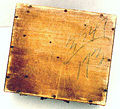
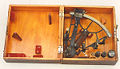
The Pensacola Sextant Box (3547 and 173)
The National Museum of Naval Aviation has a sextant box with "dovetailed corners, the number 116 handwritten on the front, and the numbers 3547 and 173 handwritten on the bottom." The box contains "a sextant manufactured by W. Ludolph of Bremerhaven, Germany, in 1919, with the serial number XIX 1090, painted black."[2] The box was donated by W. A. Cluthe, a retired Pan Am captain, who said that he had borrowed the Ludolph sextant from Fred Noonan.[3] The box is listed in the table below as Brandis (theoretical) because the box contains modifications that may have been made to accommodate a Brandis bubble sextant.
Sextant Box Numbers: Suggestive Patterns
This chart is organized in the order of the Navy number given to the instruments by the Naval Observatory when they were sent there for calibration. Two entries are theoretical; the rest are actual pairs of numbers obtained from various sources. Two of the boxes in TIGHAR's possession have Naval Observatory numbers stamped on the box along with Brandis maker's numbers stenciled on the box.
In the engraving on the sextants, there is a symbol for the Naval Observatory between "U.S. Navy" and the number issued by the Naval Observatory. The symbol is an "N" superimposed on a square "O". The symbol is relatively clear in this photograph.
All the nautical instrument repair and calibration work was shipped off to Norfolk in the early 1950s.
"Important though this work was, the Observatory was open to the criticism, especially from astronomers, that navigational instruments should be no part of the work of an astronomical observatory. This was undoubtedly part of the reason that the chronometer function was transferred in 1951 to the Norfolk Navy Yard, leaving only a small group of instrument makers who repaired and constructed the Observatory’s telescopes and other instrumentation, rather than navigational instruments."[4]
Any sextant marked "FE Brandis" is definitely a pre-1925 or so product.
| Maker | Maker No. | Navy No. | Inspection date | Comments | Bubble | N.O. # on box |
|---|---|---|---|---|---|---|
| W&S (stamped into box and on plate) Warner & Swasey | 69 | 34 | Flying Fish Trading Co. | ? | ||
| Brandis (theoretical) | 3547 | 173 | Pensacola | ? | ||
| Brandis | 2734 | 362 | 1943-04-18 | ebay #350401896246; re-inspected 1965-11-12 | no | yes (die-punched) |
| K&E | 18446 | 405 | Smithsonian | yes | ||
| K&E (in W&S box) | 4940 | 415 | 1936-01-29 | Flying Fish Trading Co. | no | |
| K&E | 5418 | 575 | 1918-04-16 | Mystic Seaport | no | |
| Brandis | 3227 | 845 | Mariner's Museum | no | ||
| Buff & Buff | 11778 | 1065 | 1918-05-12 | eBay | no | |
| Buff & Buff | 11949 | 1144 | eBay | no | ||
| Brandis | 1146 | 1921-08-27 | eBay | no | ||
| Buff & Buff | 13069 | 1248 | ebay. | n/a | ||
| Brandis | 3339 | 1415 | 1942-12-26 | Antique Helper | No | Yes |
| Brandis | 3444 | 1461 | eBay. | no | No, box is for a Buff & Buff | |
| Brandis (theoretical) | 3500 | 1542 | Niku | ? | maybe | |
| K&E | 37548 | 1555 | 1919-10-24 | Mariner's Museum | no | |
| Brandis (box only) | 3483 | 1567 | 1932-01-27 | ebay | no | |
| Brandis | 3987 | 1584 | 1938-11-30 | TIGHAR | no | yes |
| Brandis (sextant only) | 3511 | 1585 | TIGHAR (sextant only) | no | ||
| Brandis (box only) large box | 3527 | 1599 | 1933-05-04 | TIGHAR (box only) | yes | |
| Brandis | 4297 | 1880 | 1939-09-18 | TIGHAR - McKenna | no | yes |
| Brandis | 4672 | 1889 | eBay (reported 11/17/2011 on AE Forum by D.P.Cotts) | no | no | |
| Brandis | 4345 | 1914 | ebay. metal tag: 61071 000065. Inside edge: (pencil) serial 1914; Brandis stamp: 4001. | no | no | |
| Brandis | 4319 | 1960 | ebay | no | (in box for 3483/1567) | |
| Brandis (box is for 4234) | 4279 | 2531 | 1941-07-23 | Flying Fish Trading Co. | no | |
| Brandis | 4994 | 2741 | 1942-05-25 | eBay (reported 12/05/2011 on AE Forum by D.P.Cotts) | no | |
| Brandis | 4946 | 2785 | TIGHAR | no | ||
| Brandis (no box) | 4180 | 2859 | eBay | |||
| Brandis | 4180 | 2895 | Bill Morris | no | ||
| Brandis (box only) | 5310[5] | 2919 | 1946-03-07 | eBay; Survey | ||
| Brandis | 5620 | 2939 | 1919 | Smithsonian | no | |
| Brandis | 5292 | 2975 | 1919-03-26 | Russ Dickey | yes | |
| Brandis | 5296 | 2977 | 1919-03-16 | Smithsonian | yes | |
| Brandis | 5109 | 4067 | eBay | no | ||
| Brandis | 5375 | 4125 | ebay | yes | ||
| Brandis | 4487 | 4220 | ebay | no | Box for 4037. | |
| Brandis | 4765 | 4267 | 1938-11-15 | ebay | no | Appears to be 4765. |
| Brandis | 4762 | 4334 | eBay | ? | ||
| Brandis | 4144 | 4449 | Bill Morris | no | ||
| Brandis | 3826 | 4603 | eBay | no | Brass plaque on box: "248 US Navy 101009" | |
| Brandis | 4313 | 4665 | Bruce Thomas | no | No box. In display case from USS Hancock. | |
| Brandis | 5760 | 4705 | Smithsonian | no | ||
| Brandis | 3336 | 4773 | eBay (no box) | no | ||
| Brandis | 3320 | 4799 | eBay (reported 11/22/2011 on AE Forum by D.P.Cotts) | no | no | |
| Mergenthaler | 5083-44 | 1945-03-27 | Only the box; ebay. | n/a | ||
| Mergenthaler | 5223-44 | 1945-01-04 | MK. I. Mod. 0; ebay | no | Note on box for 5878-44 | |
| David White (1943) | 11949 | 5508 | eBay | no | ||
| David White (1941) | 5273 | USNO Historical Committee Inv | ||||
| Mergenthaler | 5878-44 | MK. I. Mod. 0; ebay | no | In box for 5223-44 | ||
| David White (1941) | 9746 | eBay (reported 10/15/2011 on AE Forum by A.McKenna) was used on USS Hector | no | 13692 stamped on brass plate affixed above lid latches | ||
| David White (1943) | 17649 | 17649-43 | 1946-07-19 | eBay | no | |
| No Navy numbers or not known | ||||||
| Brandis | 1844 | ? | eBay; plate on box containing 4762 | |||
| Brandis | 3193 | none | Smithsonian | yes | ||
| Brandis | 3702 | none | e-bay. Large "916" stenciled in gold on box. | no | "916"? | |
| Brandis | 4001 | ? | eBay; box for 4345 | no | ||
| Brandis | 4037 | ? | eBay; stencil on box for 4487 | |||
| Brandis | 4234 | ? | stencil on box | |||
| Brandis | 5360 | ? | eBay; stencil on box for 3987 | |||

Looking for patterns in the data
There seems to be some correlation between the dates of calibration by the Naval Observatory and the number given to the sextant by the Observatory.
The numbers issued in 1919 seem to be in ascending order by date, but they are out of sequence compared to the rest of the table.
With the 1919 numbers removed, most of the rest of the numbers are in ascending order by date. Two of those sextants (2977 and 2975) are bubble mods for the Navy transatlantic flight in May of that year.
| Maker | Maker No. | Navy No. | Inspection date |
|---|---|---|---|
| K&E (in W&S box) | 4940 | 415 | 1936-01-29 |
| K&E | 5418 | 575 | 1918-04-16 |
| Buff & Buff | 11778 | 1065 | 1918-05-12 |
| K&E | 37548 | 1555 | 1919-10-24 |
| Brandis (box only) | 3483 | 1567 | 1932-01-27 |
| Brandis | 3987 | 1584 | 1938-11-30 |
| Brandis (box only) large box | 3527 | 1599 | 1933-05-04 |
| Brandis | 4297 | 1880 | 1939-09-18 |
| Brandis (box is for 4234) | 4279 | 2531 | 1941-07-23 |
| Brandis | 5620 | 2939 | 1919 |
| Brandis | 5296 | 2977 | 1919-03-16 |
| Brandis | 5292 | 2975 | 1919-03-26 |
| Brandis | 4765 | 4267 | 1938-11-15 |
| David White (1943) | 17649 | 17649-43 | 1946-07-19 |
Discussion
- Ric Gillespie
- If we throw out the 1919 numbers as an anomaly, along with K&E #4940, we can say that the assignment of N.O. number 1542 (on the Niku box) might have occurred circa 1930/31 and that the instrument was still in the Navy inventory at that time. Noonan went to work for Pan Am in 1930. Pan Am acquired the landing rights to Honolulu, Midway, Wake and Guam in 1934 and began assembling its Pacific Division with Noonan as the lead navigator.
- In other words, Noonan's acquisition of Brandis 3500/N.O. 1542 as surplus sometime between 1934 and 1936 seems possible.
- Art Rypinski
- Keep in mind that Brandis made thousands of sextants during the period 1918-1920 or so, which left the peacetime Navy with far more sextants than they could ever use. The Naval Observatory Annual Reports for the period describe surplusing of large number of instruments. According to the Smithsonian, Brandis was acquired by the Pioneer Instrument Co. in 1922, and "the manufacture of Brandis instruments ceased in 1932." I think it would be reasonable to believe that almost all of the Brandis sextants in circulation were actually manufactured in 1918-1920, and that none were manufactured after 1932. Further, the Naval Observatory appears to have changed its numbering plan (at least for aviation octants) in the late 1920s, and begin issuing NO numbers with the form XXXX-YY, where YY was the year of original calibration. Therefore, I believe that all of the post-1930 calibration dates are recalibrations of sextants that were originally calibrated and issued their NO numbers in 1918-1920. Hence, I hypothesize that neither the maker’s number nor the NO number of sextants calibrated after 1930 has any relationship with the calibration date.
- 3500/NO 1542 could have been surplused and put into private hands at any point after 1920. If 3500/1542 was a Byrd Sextant, however, I speculate that it would have been relatively rare and would have been kept in service until aviation octants became relatively plentiful--say, early 1930s?
Photo Gallery
-
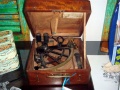
Brandis 4279 in 4234 box.
-

Brandis 4279: Navy Sticker.
-
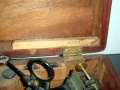
Brandis 4279 box: stenciled number 4234.
-

Brandis 4946. Standard sextant & box.
-

Brandis 5292. Byrd bubble added.
-
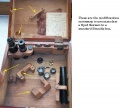
Brandis 5292. Box modifications.
-
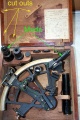
Brandis 5292 in modified box.
-
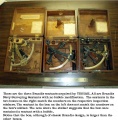
Box comparisons.
-
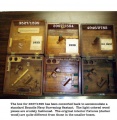
Box comparisons.
-

K&E 4940/Navy 415 in box for W&S 069/Navy 34.
-
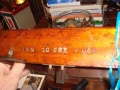
W&S maker's number on box.
-
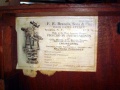
Brandis sticker in W&S box with K&E sextant.
-

K&E 4940. Naval Observatory inspection 1/29/36.
-

Why no mods in box lid?
-

1943 David White box.
-

Naval Observatory number on 2975.
-

Magnifying glass on 2785.
-

Pensacola sextant--top view.
-
Pensacola: 3547 / 173.
-
Ludolph in Pensacola box.


Links
- Sextants at Greenwich: a catalog by W.F.J. Mörzer Bruyns and Richard Dunn.
- The Nautical Sextant by Bill Morris.
- Blog entry about the restored sextant.
- Update on Restoration of a Byrd Sextant--excellent photograph/diagram.
References
- ↑ "Update on Byrd Aircraft Sextant."
- ↑ Shoes p. 232.
- ↑ Ibid. p. 233.
- ↑ Sky and Ocean Joined: The U.S. Naval Observatory, 1830-2000, by Steven J. Dick, Cambridge University Press, 2003; p. 507.
- ↑ The collimation label gives the Maker No. as 2919. 5310 is stamped in ink on the box while 2919 is impressed in the wood.