Lockheed Electra 10E Special - NR16020: Difference between revisions
m (correct TTracks URL) |
No edit summary |
||
| Line 40: | Line 40: | ||
|- | |- | ||
|1151 gallons of fuel @ 6 lbs per gallon | |1151 gallons of fuel @ 6 lbs per gallon | ||
|align="right"| | |align="right"|6906 | ||
|- | |- | ||
|Fuel oil @ 7 lbs per gallon | |Fuel oil @ 7 lbs per gallon | ||
Revision as of 14:25, 13 March 2011
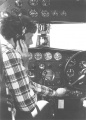
Joe Gurr: "The airplane, a Lockheed No. NR 16020, was really fascinating. It was obviously engineered and equipped for very long non-stop flights. The fuselage was solid gasoline tanks, two rows of them, from bulkhead to bulkhead, with just enough room between the tops of the tanks and the overhead for a person to be able to crawl from the stern to the cockpit on their tummy. Located in the stern, just opposite the main entrance door was a small table for the navigator's use. The radio transmitter was installed above this table. Jammed in what space they could find was a toilet."[1]
- "Gurr's recollections do not correspond exactly to what is known about the aircraft: there was just one row of tanks, the transmitter was below the table, and the toilet was in a standard location."[2]

Powerplants
"Lockheed had introduced the Model 10A Electra in 1934. Powered by two Pratt & Whitney Wasp Jr. SB engines of 450 h.p., the type enjoyed widespread success as a ten-passenger airliner. Deliveries of the 10E variant, featuring the more powerful 550 h.p. Wasp S3H1, began in January 1936. Earhart’s was the fifth airframe so equipped." [3]
"There's no such thing as a 'Wasp Senior.' The P&W R1430 was known as the 'Wasp.' The Model 10A Electra carried the smaller R985 which was dubbed the 'Wasp Junior' but nobody ever referred to the big engine as a 'Wasp Senior.' All Model 10Es were built with P&W R1430 S3H1 Wasp engines and NR16020 was wearing the same engines it was built with when it disappeared."[4]
Windows come and go
"As delivered in July 1936, the airplane had only two windows in the cabin. These were the aftmost standard airline windows and were directly opposite each other. Then in January of 1937 a window was installed in the cabin door on the port side and a larger-than-standard window was installed on the starboard side. This last window is the one that was later skinned over in Miami."[5]
Weight and Fuel Capacity
The License Authorization says "Weight empty as equipped 7265 lbs. (see equipment reverse side)."
On the reverse side it says, "Gas tanks: 6 in wing @ 394 gal. 6 in fuselage @ 754 gal." That's a total of 1148 gallons.
This was when the airplane was registered as R-16020 and it was sometime before 27 November 27 1936 when the total fuel capacity was increased to 1151.
At the bottom of the reverse side of the License Authorization it says:
The following values shall be considered when computing the gross load:
- Gasoline at 6 lbs
- fuel oil 7 lbs
- Lubricating oil 7.5 lbs per gallon
- Weight of equipment not listed above
- Passengers and crew at 170 lbs each
- Baggage and cargo at actual weight
| Item | Weight |
|---|---|
| Airframe | 7265 |
| 1151 gallons of fuel @ 6 lbs per gallon | 6906 |
| Fuel oil @ 7 lbs per gallon | |
| Lubricating oil @ 7.5 lbs per gallon | |
| Other equipment | |
| 2 crew @ 170 lbs each | 340 |
| Total: | |
| Baggage and cargo |
Earhart said her plane's Gross Weight was about 15,000 pounds when fully loaded with 1150 US Gallons of fuel.
Gallery
-
-
-

-
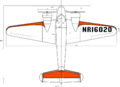 55' x 38' 7"
 -

-
-
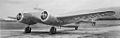
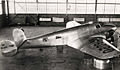 Wheeler Field
19 Mar 1937 -
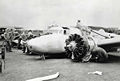 Luke Field
20 March 1937


| All drawings, images, and photographs ©TIGHAR 1985-2024. Not to be used, distributed, copied, bought, sold, or otherwise poached. For permission to use images, please email TIGHAR. |
References
- ↑ Joe Gurr to Fred Goerner, 3 May 1982.
- ↑ Ric Gillespie, 2 March 2009 Forum.
- ↑ TIGHAR Tracks 1995 11:2.
- ↑ https://tighar.org/smf/index.php/topic,290.msg2728.html#msg2728
- ↑ Ric Gillespie, 31 May 2000 Forum.
Related articles
- Radio equipment on NR16020.
- "The Earhart Electra, part I: A Star is Born," 31 May 1995 TIGHAR Tracks.
- "The Earhart Electra, part II: Around the World," 9 November 1995 TIGHAR Tracks.
- Lockheed Martin archive
- Lockheed Report 487 on the Electra's range.
- The Harney Drawings]--detailed plans for the interior and exterior of the Electra (available from TIGHAR).
- Lockheed 10-A.
- [1] "History Detectives Report: A Piece of the Grail?"]