Government Station: Difference between revisions
No edit summary |
No edit summary |
||
| Line 1: | Line 1: | ||
The '''Government Station''' was a group of buildings located in [[the village]]. | The '''Government Station''' was a group of buildings located in [[the village]]. | ||
== Rest House == | |||
In describing the Rest House at the Government Station, Laxton wrote: | |||
"An American lady who had visited with us earlier when the house had been unoccupied for some time had proceeded to the lavatory, which is of the 'thunder-box' variety, and found it full of dynamite having been allocated by the island government as an explosive store. This adjusted, she later washed in the neat and impressive handbasin, with tap, plug and all, mentally apologizing for reproaching the British with push-pull sanitation; on removing the plug the water gurgled happily away, emerging immediately around her feet. A bucket should stand below to receive the waste. These and similar details had been squared away before our arrival...."<ref>Paul Laxton's article "Nikumaroro," published in the Journal of the American Polynesian Society Vol. 60 Nos. 2 &3, June and September 1951.</ref> | |||
<gallery> | <gallery> | ||
File:Figure 8.jpg | File:Figure 8.jpg | ||
| Line 7: | Line 12: | ||
File:Gallhouse2.jpg| The Rest House, [[Niku I (1989)]]. | File:Gallhouse2.jpg| The Rest House, [[Niku I (1989)]]. | ||
</gallery> | </gallery> | ||
== References == | |||
<references /> | |||
<!-- Categories --> | <!-- Categories --> | ||
Latest revision as of 01:21, 1 January 2011
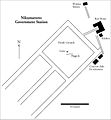
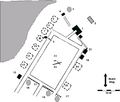
The Government Station was a group of buildings located in the village.
Rest House
In describing the Rest House at the Government Station, Laxton wrote: "An American lady who had visited with us earlier when the house had been unoccupied for some time had proceeded to the lavatory, which is of the 'thunder-box' variety, and found it full of dynamite having been allocated by the island government as an explosive store. This adjusted, she later washed in the neat and impressive handbasin, with tap, plug and all, mentally apologizing for reproaching the British with push-pull sanitation; on removing the plug the water gurgled happily away, emerging immediately around her feet. A bucket should stand below to receive the waste. These and similar details had been squared away before our arrival...."[1]
-
-
-

-
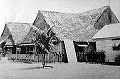
The Rest House, 1941.
-
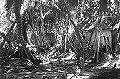
The Rest House, Niku I (1989).


References
- ↑ Paul Laxton's article "Nikumaroro," published in the Journal of the American Polynesian Society Vol. 60 Nos. 2 &3, June and September 1951.