Corks found on Nikumararo: Difference between revisions
No edit summary |
No edit summary |
||
| Line 22: | Line 22: | ||
Image:AE waterbag detail1.jpg | Image:AE waterbag detail1.jpg | ||
Image:AE waterbag detail2.jpg | Image:AE waterbag detail2.jpg | ||
Image:WaterbagBMI.jpg | Image:WaterbagBMI.jpg|Baltimore Museum of Industry | ||
Image:WaterbagBMI detail1.jpg | Image:WaterbagBMI detail1.jpg|Baltimore Museum of Industry | ||
</gallery> | </gallery> | ||
This water bag's mouth looked like aluminum (to me) and the threaded cap was attached with a string (no chain). The top of the water bag was closed with a flat steel sheet plus unusual curved hooks.<ref>Rypinski to [[EPAC]], 23 May 2009</ref> | With reference to the last two photos: "This water bag's mouth looked like aluminum (to me) and the threaded cap was attached with a string (no chain). The top of the water bag was closed with a flat steel sheet plus unusual curved hooks."<ref>Rypinski to [[EPAC]], 23 May 2009</ref> | ||
== References == | == References == | ||
<references/> | <references/> | ||
Revision as of 18:04, 18 August 2009
Near the bones found on Nikumaroro, Gallagher found "corks on brass chains." The number of corks and chains was not specified in the bones file nor was there any description of whether the corks and chains were linked to each other or independent (one chain per cork?). If the corks were measured in any way, the measurements were not entered into the records TIGHAR has found to date.
The corks and chains were sent to WPHC headquarters in Suva, Fiji.
On July 1, 1941, K. R. Steenson, Senior Medical Officer, G.&E.I.C. wrote Vaskess: "Those corks on brass chains would appear to have belonged to a small cask."
If the corks belonged to a cask, they may have come from the cache that the Norwich City survivors left on the island.


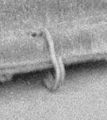
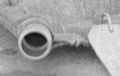
It is also conceivable that the corks came from canvas water bags. No such bags are listed on the Luke Field inventory, but a photograph from 1937 does show a canvas water bag.
Photos by Art Rypinski:
-
-
-

Baltimore Museum of Industry
-
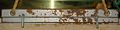
Baltimore Museum of Industry


With reference to the last two photos: "This water bag's mouth looked like aluminum (to me) and the threaded cap was attached with a string (no chain). The top of the water bag was closed with a flat steel sheet plus unusual curved hooks."[1]