Corks found on Nikumararo: Difference between revisions
No edit summary |
|||
| (16 intermediate revisions by one other user not shown) | |||
| Line 5: | Line 5: | ||
On July 1, 1941, [[Steenson| K. R. Steenson]], Senior Medical Officer, [[G.&E.I.C]]. wrote [[Vaskess]]: "Those corks on brass chains would appear to have belonged to a small cask." | On July 1, 1941, [[Steenson| K. R. Steenson]], Senior Medical Officer, [[G.&E.I.C]]. wrote [[Vaskess]]: "Those corks on brass chains would appear to have belonged to a small cask." | ||
If the corks belonged to a cask, they may have come from the cache that the [[Norwich City]] survivors left on the island. | If the corks (typically called a bung in relation to a barrel) belonged to a cask, they may have come from the cache that the [[Norwich City]] survivors left on the island. | ||
[[Cask1.jpg| | [[Cask1.jpg|Click here for discussion of the cask in the photos]]: | ||
Photos by Andrew McKenna | |||
<gallery> | <gallery> | ||
Image:Photo_Library_-_376.jpg | Image:Photo_Library_-_376.jpg | ||
| Line 16: | Line 17: | ||
</gallery> | </gallery> | ||
It is also conceivable that the corks came from [http://ernielb.blogspot.com/2008/05/canvas-water-bags_8692.html canvas water bags.] No such bags are listed on the [http://www.tighar.org/Projects/Earhart/Documents/Luke_Field.html Luke Field inventory,] but a [http://pro.corbis.com/Enlargement/Enlargement.aspx?id=U401403AACME photograph from 1937 does show a canvas water bag.] | It is also conceivable that the corks came from [http://ernielb.blogspot.com/2008/05/canvas-water-bags_8692.html canvas water bags.] No such bags are listed on the [http://www.tighar.org/Projects/Earhart/Documents/Luke_Field.html Luke Field inventory,] but a [http://pro.corbis.com/Enlargement/Enlargement.aspx?id=U401403AACME photograph from 1937 does show Amelia with a canvas water bag included with the gear being loaded or unloaded from the Electra.] | ||
Photos by Art Rypinski: | Photos by Art Rypinski: | ||
| Line 27: | Line 28: | ||
With reference to the last two photos: "This water bag's mouth looked like aluminum (to me) and the threaded cap was attached with a string (no chain). The top of the water bag was closed with a flat steel sheet plus unusual curved hooks."<ref>Rypinski to [[EPAC]], 23 May 2009</ref> | With reference to the last two photos: "This water bag's mouth looked like aluminum (to me) and the threaded cap was attached with a string (no chain). The top of the water bag was closed with a flat steel sheet plus unusual curved hooks."<ref>Rypinski to [[EPAC]], 23 May 2009</ref> | ||
Here are some photos of a | |||
Here are some photos of a water bag owned by Andrew McKenna. This was used by my father in his paleontology field camps in the Western US. I remember them well from my childhood. I wouldn't think that these would be well suited for use in aviation as by nature they leak. The whole point of using a canvas bag made of Scottish Flax is that the material absorbs moisture and the evaporation from the exterior of the bag keeps the contents relatively cool. The downside is that they drip constantly. | |||
Note that the mouth of the bag is made of aluminum, as Art Rypinski speculates above, but it is not threaded, rather has a cork attached by a string. There is also a wood or possibly metal rod embedded inside the top edge of the water bag similar to the water bag in the 1937 photo, rather than externally attached as shown in Art's photo from the Baltimore Museum of Industry above. Note how the cork string is attached to the edge of the bag, and see that there is a similar feature on the bag in the 1937 photo. | |||
Photos by Andrew McKenna | |||
<gallery> | |||
Image:AMCKWaterBag1.jpg|Safari Water Bag | |||
Image:AMCKWaterBag2.jpg|Note the aluminum grommet | |||
Image:AMCKWaterBag3.jpg|Guaranteed Scotch Flax! | |||
Image:AMCKWaterBag4.jpg|Aluminum Mouth | |||
Image:AMCKWaterBag8.JPG|Detail of the Mouth | |||
Image:AMCKWaterBag6.jpg|Note the copper (?) wire fastener for the rope end | |||
</gallery> | </gallery> | ||
For fun, I've tried to re-create the 1937 photo of the water bag. I think the rope and the cork are simply out of sight under the bag in the 1937 photo. You can see part of the rope under the front edge of the bag, as well as off to the right. | |||
<gallery> | |||
Image:Waterbag1937.JPG | |||
Image:WaterBag7.JPG | |||
</gallery> | </gallery> | ||
== References == | == References == | ||
<references/> | <references/> | ||
<!-- Please leave this category marker at the bottom. You may add this article to other categories if you wish --> | |||
[[Category:Collected by Gallagher]] | |||
Latest revision as of 19:03, 12 October 2009
Near the bones found on Nikumaroro, Gallagher found "corks on brass chains." The number of corks and chains was not specified in the bones file nor was there any description of whether the corks and chains were linked to each other or independent (one chain per cork?). If the corks were measured in any way, the measurements were not entered into the records TIGHAR has found to date.
The corks and chains were sent to WPHC headquarters in Suva, Fiji.
On July 1, 1941, K. R. Steenson, Senior Medical Officer, G.&E.I.C. wrote Vaskess: "Those corks on brass chains would appear to have belonged to a small cask."
If the corks (typically called a bung in relation to a barrel) belonged to a cask, they may have come from the cache that the Norwich City survivors left on the island.
Click here for discussion of the cask in the photos:
Photos by Andrew McKenna


It is also conceivable that the corks came from canvas water bags. No such bags are listed on the Luke Field inventory, but a photograph from 1937 does show Amelia with a canvas water bag included with the gear being loaded or unloaded from the Electra.
Photos by Art Rypinski:
-
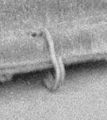
Detail, 1937 photograph
-
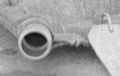
Detail, 1937 photograph
-

Baltimore Museum of Industry
-
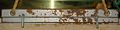
Baltimore Museum of Industry


With reference to the last two photos: "This water bag's mouth looked like aluminum (to me) and the threaded cap was attached with a string (no chain). The top of the water bag was closed with a flat steel sheet plus unusual curved hooks."[1]
Here are some photos of a water bag owned by Andrew McKenna. This was used by my father in his paleontology field camps in the Western US. I remember them well from my childhood. I wouldn't think that these would be well suited for use in aviation as by nature they leak. The whole point of using a canvas bag made of Scottish Flax is that the material absorbs moisture and the evaporation from the exterior of the bag keeps the contents relatively cool. The downside is that they drip constantly.
Note that the mouth of the bag is made of aluminum, as Art Rypinski speculates above, but it is not threaded, rather has a cork attached by a string. There is also a wood or possibly metal rod embedded inside the top edge of the water bag similar to the water bag in the 1937 photo, rather than externally attached as shown in Art's photo from the Baltimore Museum of Industry above. Note how the cork string is attached to the edge of the bag, and see that there is a similar feature on the bag in the 1937 photo.
Photos by Andrew McKenna
-

Safari Water Bag
-

Note the aluminum grommet
-

Guaranteed Scotch Flax!
-
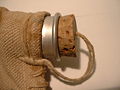
Aluminum Mouth
-

Detail of the Mouth
-

Note the copper (?) wire fastener for the rope end


For fun, I've tried to re-create the 1937 photo of the water bag. I think the rope and the cork are simply out of sight under the bag in the 1937 photo. You can see part of the rope under the front edge of the bag, as well as off to the right.


