|
 |
 |
|
 |
 |
|
|
 |
|
||
 |
|
||
May 1998
 On
February 14-16, 1998 a thirteen person TIGHAR team flew to Kanton Island to
investigate the possibility that an engine from Earhart’s plane had
been inadvertently brought there in 1971 during a U.S. Air Force missile testing
program (see TIGHAR Tracks Vol 13, Nos. 2 & 3, “The
Canton Engine”). Bruce Yoho, the individual who recovered the engine
in 1971 (and now an active TIGHAR member), came along to show us where he
dumped the Pratt & Whitney R1340 which he had found on a reef on one
of the other islands of the Phoenix Group. Although he was able to locate
the spot, we were surprised and disappointed to find that the contents of
the dump had since been buried.
On
February 14-16, 1998 a thirteen person TIGHAR team flew to Kanton Island to
investigate the possibility that an engine from Earhart’s plane had
been inadvertently brought there in 1971 during a U.S. Air Force missile testing
program (see TIGHAR Tracks Vol 13, Nos. 2 & 3, “The
Canton Engine”). Bruce Yoho, the individual who recovered the engine
in 1971 (and now an active TIGHAR member), came along to show us where he
dumped the Pratt & Whitney R1340 which he had found on a reef on one
of the other islands of the Phoenix Group. Although he was able to locate
the spot, we were surprised and disappointed to find that the contents of
the dump had since been buried.
When Bruce Yoho told us that, in 1971, he had disposed of the engine in a junkyard just off the end of the main runway at Canton Island, the first question we had was, “What happened to the junkyard when the Air Force left?” To find an answer, TIGHAR researchers went to Vandenburg AFB to examine the files of SAMTEC (Space And Missile Test Center), the 1970s missile test program of which Bruce was a part. The paperwork was extensive and it was clear that environmental concerns had a very high priority. Report after report stressed the fragility of the islands’ ecological balance and set procedures to protect plant and animal life.
As the Air Force prepared to shut down the project and leave the Phoenix
Islands in March of 1976, there was much official discussion as to how Canton
should be cleaned up. Earlier, some scrap metal had been dumped at sea but
this was determined to be expensive and dangerous. A November 1974 memo on
Environmental Conditions of Canton Island states that “Most bulky
noncombustibles are deposited in an area adjacent to the landfill, but there
are other scattered areas with minor accumulations.” The small junkyard
where Bruce dumped the engine would seem to be one of these. The report
continues, “Although the disposal areas may appear unsightly, they
are not causing any apparent environmental problems or health hazards.”
Consideration was given to building a jetty out over the reef edge for the
dumping of “bulky noncombustible wastes” but a January 1975 report
entitled Environmental Protection rejected the idea as “not feasible.”
It appeared, from our research, that the disposal areas for noncombustible
waste (such as old Pratt & Whitney airplane engines) had been left alone.
We were wrong.
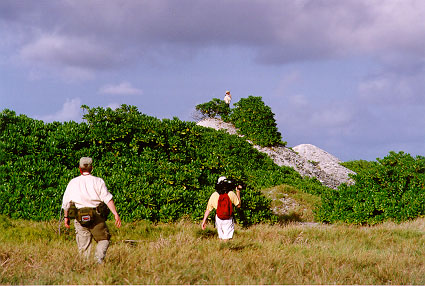
Once we were on the ground at Canton Island (officially Kanton since 1979)
it became obvious that much had been done that was not mentioned in the
official paperwork. At Bruce’s junkyard, a trench roughly the width of a
dozer blade and perhaps five feet deep had been dug about 20 yards to the
east. It appears that everything in the dump, except a disabled bulldozer
which was apparently too big to move, was then pushed into the trench and
buried. Beyond there the landscape is strewn with conical hills and gouged
valleys. But there are no hills and valleys in the coral atolls of the Phoenix
Islands. These are the burial mounds and graves of heavy equipment and other
assorted debris and would seem to be evidence of a different and much grander
disposal operation than the clean up of Bruce’s dump.
 Just
how and when all this happened is not clear, but the question now is what
to do next about finding Bruce’s (and maybe Amelia’s) engine? We’re
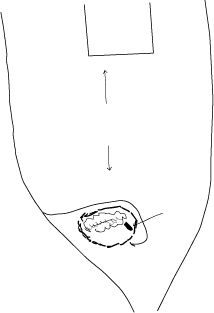
quite sure that we have the right spot. The map Bruce drew from memory turned
out to be surprisingly accurate and one of his co-workers from that time
even remembers that the junkyard contained a disabled bulldozer. The area
to be excavated is quite manageable, provided one has some power digging
equipment. There is a small, fairly new Kubota L295-II tractor in use on
the island. We’re presently investigating the cost of acquiring a backhoe
that would fit it (about $6,500) and transporting it to the island (that’s
the part we don’t have figured out yet).
Just
how and when all this happened is not clear, but the question now is what
to do next about finding Bruce’s (and maybe Amelia’s) engine? We’re
quite sure that we have the right spot. The map Bruce drew from memory turned
out to be surprisingly accurate and one of his co-workers from that time
even remembers that the junkyard contained a disabled bulldozer. The area
to be excavated is quite manageable, provided one has some power digging
equipment. There is a small, fairly new Kubota L295-II tractor in use on
the island. We’re presently investigating the cost of acquiring a backhoe
that would fit it (about $6,500) and transporting it to the island (that’s
the part we don’t have figured out yet).