|
Volume 12 Number 2/3
October, 1996 |
|
| Shoe parts (TIGHAR Artifact 2-2-G-7) |
| Date found: |
October 1991 during TIGHAR’s Niku II expedition. |
 |
|
| Identification assistance: |
Cat’s Paw, a division of The Biltrite Corporation. |
The many fragments which make up
this artifact have been cataloged under 9 separate sub-headings based upon
the nature of the material or object, and the specific spot where it was found.
|
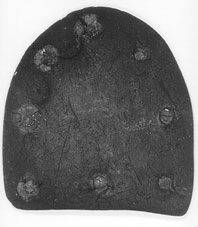
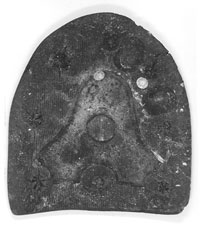
| Artifact 2-2-G-7/1, Cat’s Paw heel |
| Description: |
This is a rubber shoe heel 3 inches long by 2 and 7/8 inches
across its greatest width. It is nominally 1/4 inch thick and is pierced by
8 ferrous nails. The exterior (bottom) surface is considerably worn. The interior
surface exhibits a number of codes and markings molded in at the time of manufacture,
plus the hand-written letters RN. Two shallow depressions once held anchors
for white rubber “traction plugs.” |
| Condition: |
The rubber is hard and probably somewhat contracted. Remnants
of all eight nails are extant but severely oxidized. The washers surrounding
the nails are present in 6 of the holes. |
| Identification: |
This is a Cat’s Paw replacement heel manufactured
in the United States in the mid-1930s for a left shoe of either a large woman’s
or small man’s size. The hand-written RN may be stock coding applied by the
repair person. |
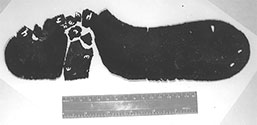
| Artifact 2-2-G-7/2 through 5, Sole |
|
| Description: |
These are fragments of a rubber
shoe sole nominally 1/4 inch in thickness. The largest fragment is 6 7/8 inches
in length and measures roughly 2 1/2 inches wide across the narrowest part
of the instep. When reassembled, the suggested length of the sole is approximately
10 7/8 inches. Eight holes are present where the heel was once attached and
the alignment precisely matches the nails in Artifact 2-2-G-7/1 (see above).
Holes along the edge where the uppers were stitched to the sole are spaced
3/16 inch apart. |
| Condition: |
The rubber is hard, brittle and probably somewhat
contracted. |
| Identification: |
This is the sole of a woman’s left shoe of a style
known as blucher oxford. The location of the stitching holes establish the
style and the tightness of the stitches (even allowing for contraction) indicate
a woman’s shoe. The length and width indicate a woman’s size 8 1/2 or 9 narrow.
The Cat’s Paw replacement heel (Artifact 2-2-G-7/1) found with the fragments
was almost certainly once attached to this sole. |
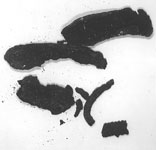
| Artifact 2-2-G-7/6 through 8 |
  |
| Description: |
These are fragments of an unknown
material (possibly leather) approximately 1/8 inch in thickness. |
| Condition: |
The material is hard, brittle and, in some cases, has curled inward along
its edges. |
| Identification: |
Unknown. These may be pieces of
the layered base which goes between the sole and the replaceable part of the
heel. |
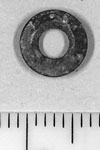
| Artifact 2-2-G-7/9, Brass eyelet |
| Description: |
This is a brass eyelet with a diameter of 5/16 inch and a depth
of 1/16 inch. The hole has a diameter of 1/8 inch. |
| Condition: |
Tarnished but otherwise undamaged. |
| Identification: |
Such an eyelet might have many uses but the context
in which it was found suggests that it was employed as a shoelace grommet.
The aperture is too small to accommodate the laces of a man’s shoe but exactly
match the traditional 1/16 inch laces for women’s shoes. |
| General Commentary: |
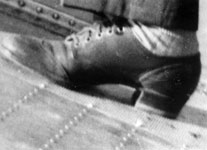 The shoe from which Artifact 2-2-G-7 originated
was a woman’s blucher oxford with brass eyelets and a replacement heel manufactured
in the United States in the mid-1930s. The size was 8 and 1/2 or 9 narrow.
The style and size of shoe worn by Amelia Earhart at the time of her disappearance
is shown in this detail from a photo taken in Bandoeng, Java about 10 days
before her final flight. Amelia is wearing a woman’s blucher-oxford with
brass eyelets. There are many photos of AE wearing these shoes. The slightly
lighter color at the bottom portion of the heel first appears in photos taken
just prior to the first world flight attempt in March, 1937 and may indicate
a replacement heel. The size of the shoe is readily determined. The rows
of rivets visible on the Lockheed’s wing are nominally 2.5 inches apart.
The shoe in the photo is slightly over 10 inches in length, in other words,
a size 8 and 1/2 or 9. The shoe from which Artifact 2-2-G-7 originated
was a woman’s blucher oxford with brass eyelets and a replacement heel manufactured
in the United States in the mid-1930s. The size was 8 and 1/2 or 9 narrow.
The style and size of shoe worn by Amelia Earhart at the time of her disappearance
is shown in this detail from a photo taken in Bandoeng, Java about 10 days
before her final flight. Amelia is wearing a woman’s blucher-oxford with
brass eyelets. There are many photos of AE wearing these shoes. The slightly
lighter color at the bottom portion of the heel first appears in photos taken
just prior to the first world flight attempt in March, 1937 and may indicate
a replacement heel. The size of the shoe is readily determined. The rows
of rivets visible on the Lockheed’s wing are nominally 2.5 inches apart.
The shoe in the photo is slightly over 10 inches in length, in other words,
a size 8 and 1/2 or 9.
Since the discovery of Artifact 2-2-G-7 was announced in 1992, there has
been a great deal of discussion about Amelia’s shoe size. A pair of size
6 dancing slippers in a Kansas museum and the recollections of Earhart’s
sister have been cited as evidence that AE had tiny feet. AE was 5 feet 8
inches tall and of thin and lanky build. Whatever size shoes she may have
worn as a girl, there can be little doubt about the size of shoe worn by
the 39 year old woman standing on the Lockheed’s wing. It is also difficult
to dismiss as coincidence, the oft-repeated story of how, in late 1938, the
first Gilbertese work party on Nikumaroro came upon the skeletal remains
of a white man and woman on the same part of the atoll where TIGHAR found
shoe fragments 53 years later. According the old story, the woman’s skeleton
was wearing American shoes, size nine narrow. |
|
|