An examination of 2-2-V-1 by metallurgists at Massachusetts Materials Research found the edges of the sheet “were extensively damaged by post-fracture mechanical rubbing and corrosion. This is expected of aluminum and its alloys when exposed to seawater and wave action, especially if that exposure has been prolonged, as would be the case for an aircraft fragment pre-dating World War II. Coral growth on this artifact is consistent with prolonged exposure.”
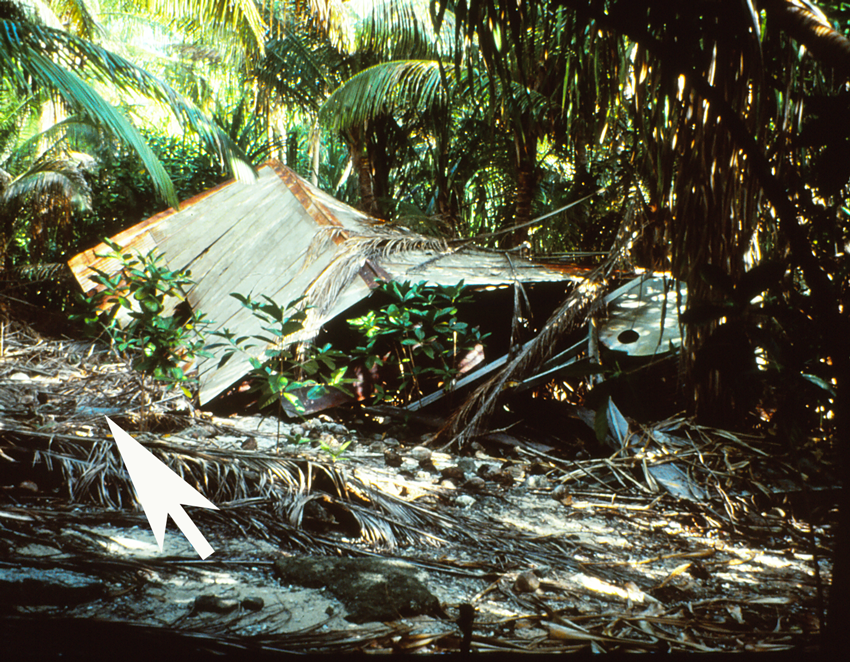
These features set the artifact apart from pieces of aircraft aluminum found in the abandoned village, none of which exhibit evidence of mechanical rubbing or coral growth.
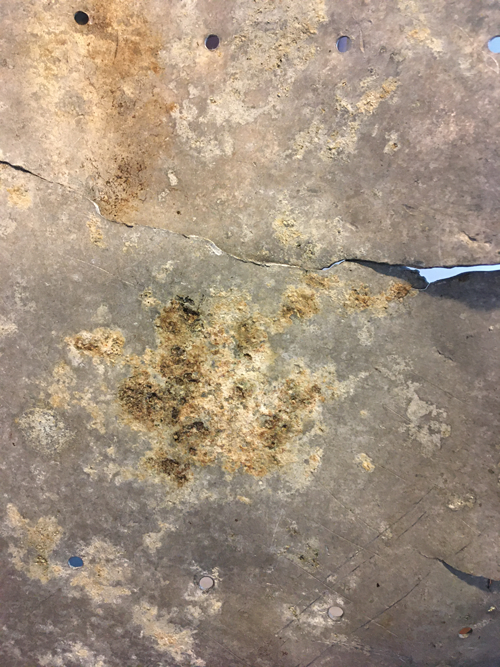
Both sides of the aluminum sheet exhibit corrosion and numerous patches of coral growth indicating prolonged submersion in sunlit seawater.
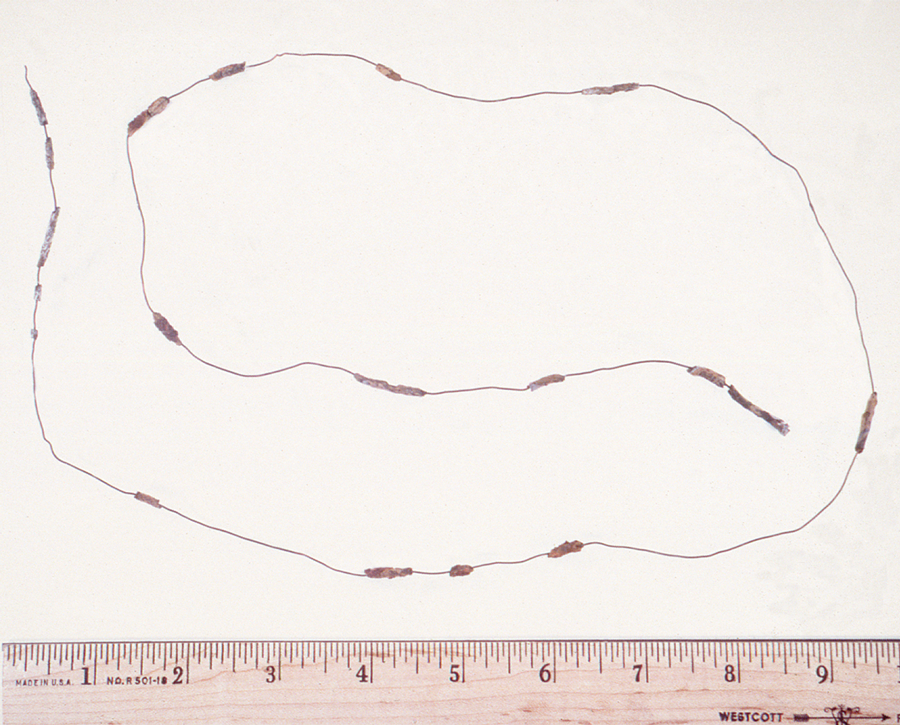
The wire found entangled in the metal sheet is missing any rubber jacketing and most of the insulation, suggesting long exposure to an abrasive environment.
Conclusion
Artifact 2-2-V-1 was submerged in sunlit seawater and mobile in an abrasive environment long enough for coral to grow on its surface and its edges to be worn smooth. Artifact 2-2-V-1a was mobile in an abrasive environment long enough to lose most of its insulation. How long the two objects had been joined together is unknown, but one or both must have been mobile in the same environment to become entangled.
Returning to the Three Hypotheses
Hypothesis #1. The wire and the sheet of aluminum in which it was entangled are debris from Earhart’s Electra.
Hypothesis #1 has the advantage of being in agreement with Occam’s Razor: “Entities should not be multiplied without necessity.” The simplest explanation is that both artifacts are debris from the same source – a 1930s-vintage aircraft. Their condition is consistent with them having made the journey southward along the reef flat from where Earhart’s Electra broke up to where the artifacts were found. The known facts support Hypothesis #1.
Hypothesis #2. The wire and the sheet of aluminum in which it was entangled are debris from some other aircraft.
The artifacts came from the ocean, not the village. Aluminum and wire do not float, so they did not come from an aircraft wreck on another island. Hypothesis #2 is not supported by the available evidence and can be dismissed.
Hypothesis #3. The wire and the sheet of aluminum in which it was entangled are unrelated and their entanglement is pure coincidence.
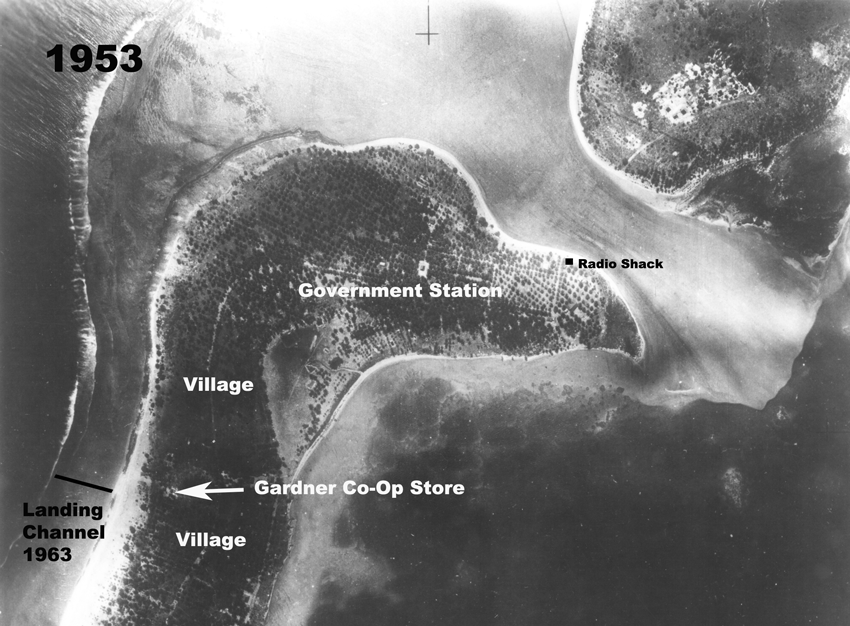
For Hypothesis #3 to be correct the wire must have a non-aviation source. That type of single-filament wire was used in other radio applications in the 1930s, so it is possible that obsolete feed line was used somewhere in the U.S. Coast Guard LORAN station built at the island’s southeastern tip in 1944 and shut down in 1946. After WWII, island residents salvaged material from the Coast Guard facility. Radio wire recovered by TIGHAR from the island’s radio shack is WWII-vintage shielded coaxial cable possibly taken from the abandoned Coast Guard facility. We’ve found no wire like 2-2-V-1a in the ruins of the LORAN station nor in the village, but that doesn’t mean such wire did not exist and was not salvaged.
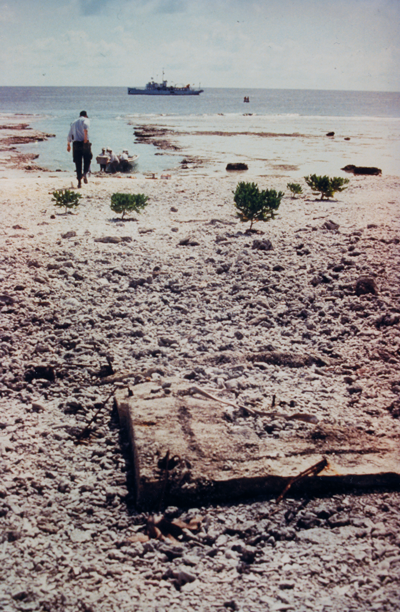
However, for the wire to become entangled on 2-2-V-1 it must be in the same place as the aluminum sheet and one or both objects must be in motion. We know 2-2-V-1 was in the ocean or on the reef flat until shortly before we found it in 1991, so the wire must have somehow also been in the water. There are no facts to support Hypothesis #3 but it cannot be categorically dismissed.
At this point in our investigation, there appears to be a high probability Artifacts 2-2-V-1 and 2-2-V-1a are debris from NR16020. We’ll next consider what that tells us about the aircraft’s fate.
|