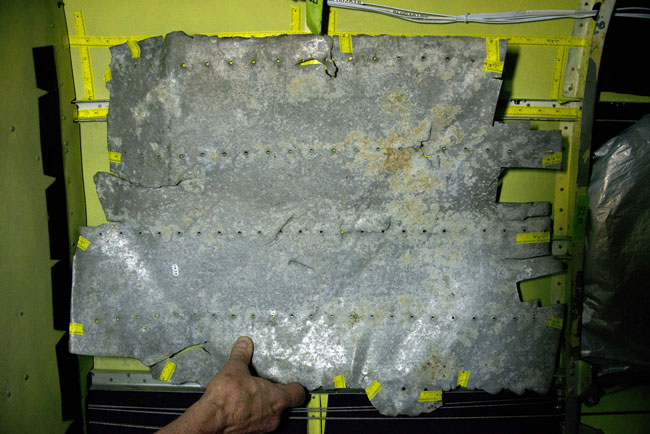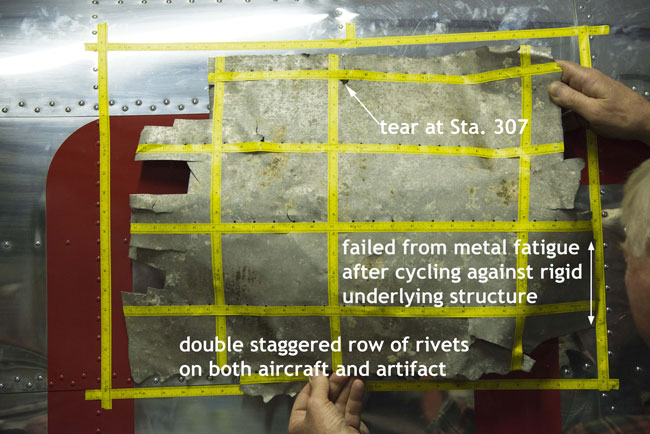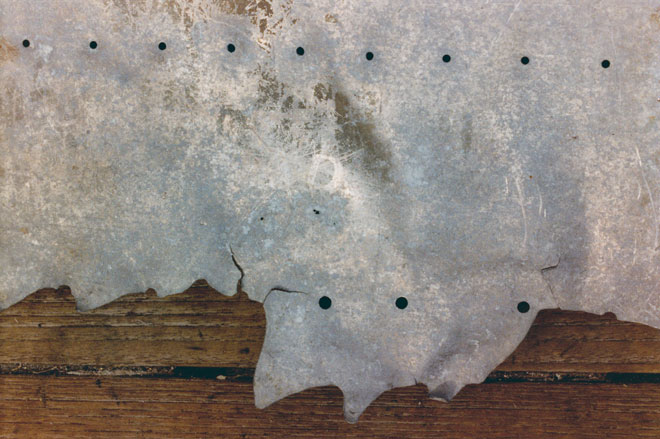

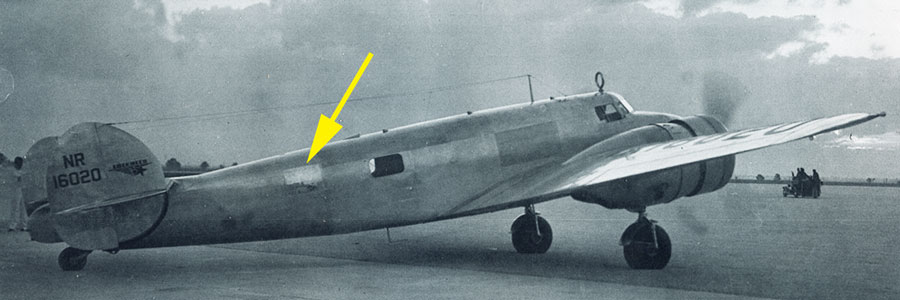
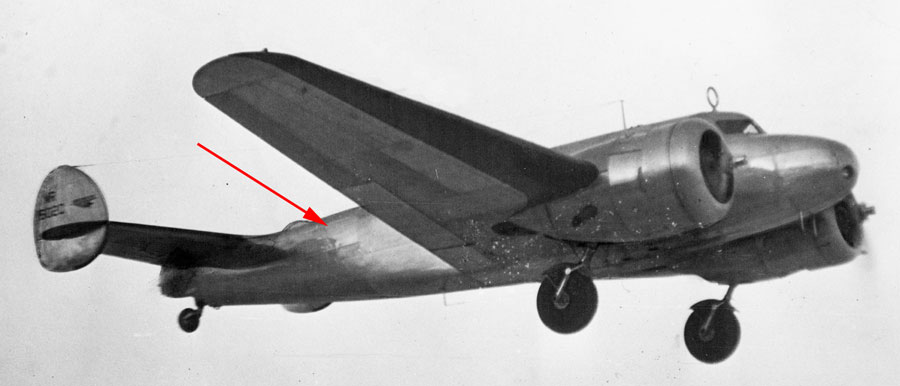

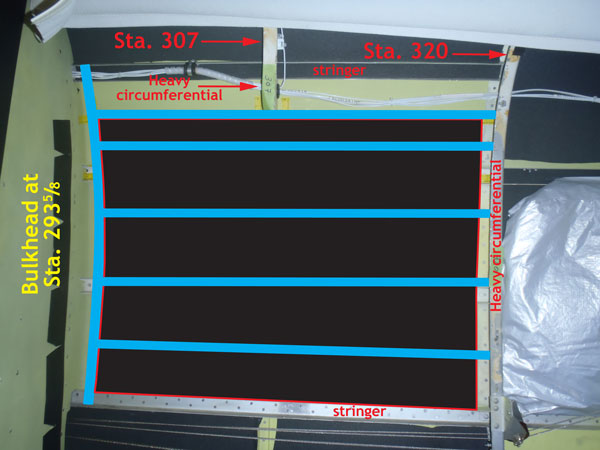
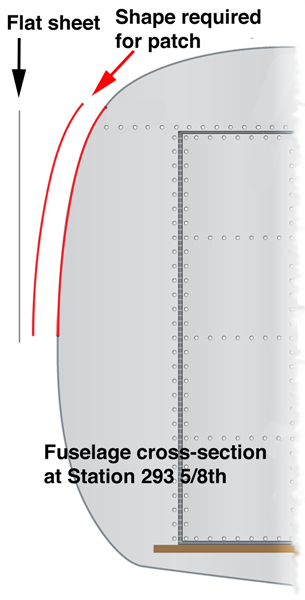
The fuselage section in that area, Station 293 5/8 to Station 320, has a slight compound curvature in the skins. The original skins were formed to accommodate this graceful and strong shape, but making a flat piece of .032 sheet stock take on the curves where it fastened and behave well in service was likely a bit tough: the new sheet, being flat in natural form, wants to behave like a section in a cylinder, whereas it must attach at the edges where the more convex compound curvature in the original skin shape is realized (rather like the shape of an old-fashioned wooden barrel, not a cylinder section).
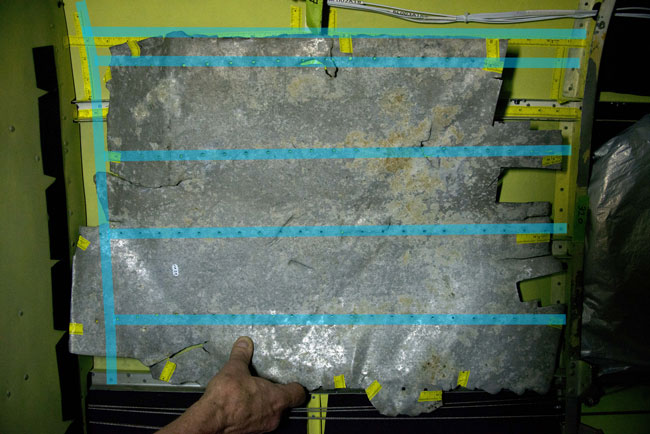
As the skin was fastened on with more fasteners as the work progressed, the installer likely had to deal with some deforming tendencies which impart both a slight “puckering” effect (think “fat wrinkles”) as more rivets were installed, and likely some “oil canning” tendencies. The expedient remedy for that can be the addition of light bracing, i.e. “stiffeners.” The pattern seen on photographs of the patch and on 2-2-V-1 reflect a logical approach to this solution given the window aperture size and the amount of compound curvature present — not so much curve that it couldn’t have been overcome, but apparently enough to require some innovative bracing.
Gradualism is the key when working a fairly large flat sheet into conformance in such a situation, and more stiffeners can work better than one or two to help coax the metal into place as rivets are driven toward completion of attachment. Multiple stiffeners would also tend to help stabilize the sheet against a tympanic oil canning effect which is the natural outcome of applying a large flat panel over an aperture of this size. Oil canning (flexing in and out) is undesirable esthetically and functionally — Earhart likely did not want the window covering to be obvious, and oil canning can be noticeably loud in flight (popping sounds). It can also actually be fatiguing to the structure; stability is the key need.
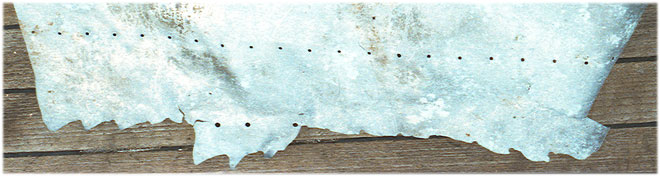
Where the four stiffeners were placed was likely dictated by a hands-on evaluation as the work progressed, and obviously it was thoughtfully done as evidenced by the straight fastener lines and equal rivet spacing. The spacing between the four lines is slightly more erratic, as there is some noticeable odd convergence and divergence: they are not entirely parallel, and they do not all converge normal to the reduction in barrel section as one moves aft. This effect strongly suggests the nature of the task in the field of molding a flat sheet into submission in this area by able hands working with limited time, materials and tools: one braces where one gets the desired effect. What we see in 2-2-V-1’s puzzle of fastener lines where stiffeners once were appears to be the end result of just such an effort.