|
July, 2002
Artifact 2-6-S-45
Secrets of the Knob Symbol #18 |
| Analysis and photos courtesy Jeff Glickman, Photek Imaging. |
|
This analysis contains 3 images which are separately annotated. Symbol #18 is heavily encrusted, and damaged. |
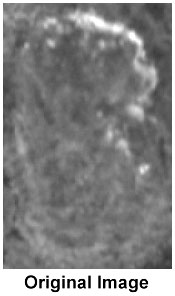
Original Image: This is the original image of symbol #18.
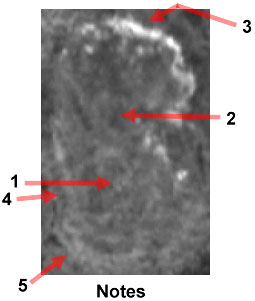
Notes:
- Inner loop, or concavity.
- Concavity.
- Ambiguous top edge – Curved or flat.
- Possible left-hand edge.
- Lower curvature.
A 0 requires a curved top and a curved bottom, and either convex or straight left and right edges. There is minimal support for these features in symbol #18. This excludes a 0.
A 1 needs a narrow width, horizontal top. There is no support for this as symbol #18 has a wide curved top. A 1 needs long vertical edges. There is no support for this in symbol #18. This excludes a 1.
A 2 requires a short edge to the top left, top curvature, and a diagonal from the lower-left to the upper right, and a wide flat bottom. There is minimal support for these features. This excludes a 2.
A 3 requires a short edge to the top left, a concavity on the right-hand edge, and lower curvature. There is minimal support for these features in symbol #18. This excludes a 3.
A 4 needs a left-hand vertical edge, or a diagonal from the middle-left to the upper right, and a vertical right-edge. There is no support for any of these features. This excludes a 4.
A 7 needs a wide horizontal top, and a diagonal from the lower left to the upper right, and a narrow foot in the lower-left. There is no support for 2 of these features. This excludes a 7.
An 8 requires a closed loop on both the top and the bottom (requires upper and lower curvature, and left and right concavities). Symbol #18 has minimal support for these features. This excludes an 8.
A 9 requires a closed loop on the top. A 9 also requires a diagonal line from the lower-left to the upper right, and a narrow, horizontal foot. There is minimal support for this in symbol #18. This excludes a 9.
A 5 needs a wide horizontal top, a top-left corner, and a short left-hand vertical edge from the top, and lower curvature. Symbol #18 supports these features.
A 6 requires a left-hand straight vertical edge, or convex edge. A 6 requires a lower loop with lower curvature, and a right-edge concavity. Note number 4 points out a small vertical section which may differentiate the symbol as a 6 vs. a 5.
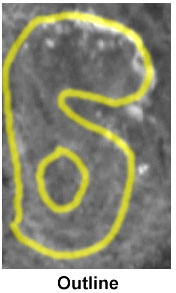
Outline: The yellow overlay is the hypothetical outline of symbol #18. This overlay is the partial outline for a “6” which is supported by the evidence.
Conclusion: The symbol features suggest TIGHAR artifact 2-6-S-45 symbol #18 is probably a six (“6”). The most likely first alternate is a five (“5”).
Jeff Glickman •
Photek •
Board Certified Forensic Examiner •
Fellow, American College of Forensic Examiners •
503-949-6200  |
|
Symbol
#18 |
|||